
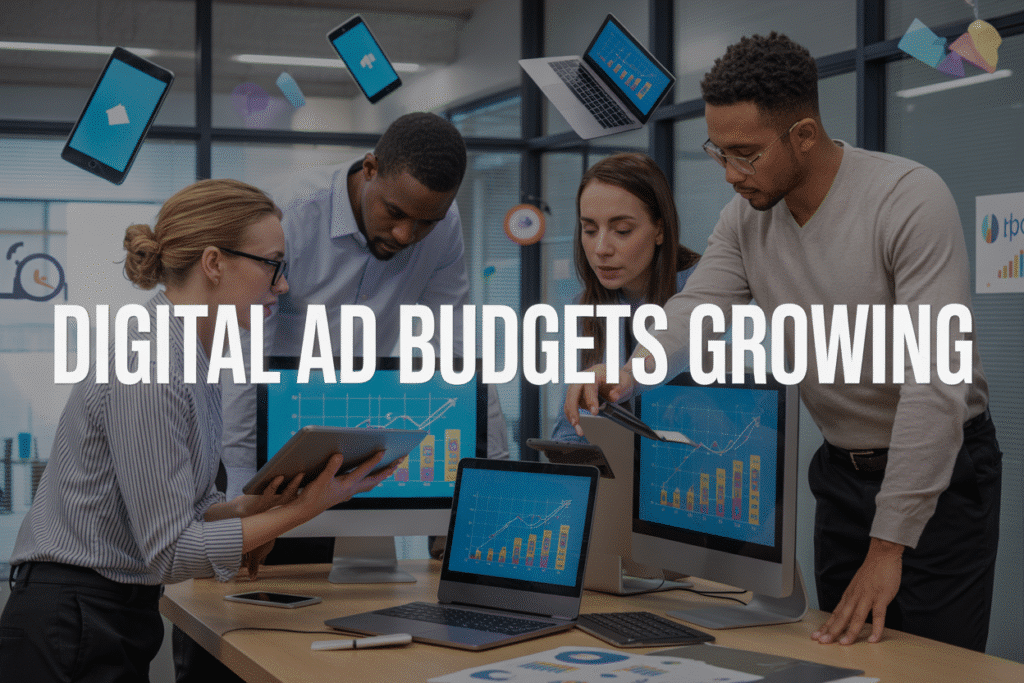
Digital advertising budgets are rising rapidly as business owners increasingly realize the importance of investing in online marketing. Whether it’s the medical sector, education, food industry, or grocery business, running digital advertising has become essential in today’s competitive market.
If you are a business owner, marketing manager, or digital marketer, and you want to achieve better results from your ad spend, this blog is for you.
How to Maximize Your Digital advertising Budget: Key Insights for Business Growth
Digital advertising is no longer optional — it’s essential for businesses of all sizes. In this blog, we will cover three important topics that can help you get the most out of your ad spend:
1️⃣ Choosing the Right Advertising Channels
Not all digital advertising channels are equally effective for every business. Whether it’s social media, Google Search, video platforms, or programmatic ads, choosing the right channel depends on your business type, target audience, and goals.
2️⃣ Optimizing Your Ad Budget
Spending money on ads is one thing; using it effectively is another. Here’s how to make every rupee count.
3️⃣ Strategies for Both Small and Large Businesses
Whether you run a small local business or a large enterprise, these strategies can help your business grow
The rapidly growing demand for the digital advertising market
In today’s world, the success of any business is directly linked to its online presence. Consumers are increasingly turning to the internet for every need — from shopping to food delivery.
For example:
If someone wants to buy a dress, they first search online before visiting a store.
If they are going to purchase a product in-store, they often check online prices first.
Morning tea? People order milk via Blinkit.
Grocery shopping? Instamart delivers in minutes.
Dining at home? Zomato or Swiggy brings meals to the doorstep.
The trend is clear: internet usage is skyrocketing, and customer behavior is moving online.
What digital advertising Means for Businesses
If a business fails to show its presence online, it risks losing potential customers. Consumers today expect to find products, services, and reviews with a simple search or a few taps on their phone. Without visibility on digital platforms, even the best products may go unnoticed.
A strong website and social media presence is no longer optional.
Online ads, search engine visibility, and social media engagement connect businesses with their target audience effectively.
Businesses that embrace digital transformation can reach more customers, build trust, and increase sales.
- Real-Time Insights: The Biggest Advantage of Digital advertising
The biggest advantage of digital advertising is that it allows businesses to track their growth in real time. Unlike traditional advertising channels like TV, radio, or newspapers, digital platforms provide instant insights into how your ads are performing.
For example:
Reach: How many people saw your ad.
Engagement: How many people showed interest by clicking, liking, or sharing.
Cart Activity: Who added your products to their cart.
Conversions: How many people actually purchased your product.
All of this data is available online, in real time, allowing businesses to optimize their campaigns instantly.

Strategy for allocating digital advertising budgets for businesses
Before setting up an ad on a social media platform, it is important to consider the type of business you have. Based on that, you need to plan your targeting carefully, including your target audience, their age group, location, and interests.
For example, if you are running an ad for a baby product, you would target females who have recently had a baby. If you are promoting a pain relief oil, your target audience would be in the 50-60 age group. Similarly, if your product is sold only in a specific region of India, you should target that particular state.
Facebook and Instagram are more useful for B2C businesses, and around 40-50% of the ad budget can be allocated here. On the other hand, LinkedIn is more suitable for B2B businesses, where investing about 25-30% of the budget is considered effective.
The majority of the budget in Google Ads is usually invested in search campaigns because they deliver better conversion rates. For display advertising, allocating 15-20% of the ad
plateform | B2C Budget % | B2B Budget % | Main Benefit |
|---|---|---|---|
Google Ads | 35-45% | 40-50% | High Intent Traffic |
Facebook/Instagram | 40-50% | 20-30% | Audience Targeting |
5-10% | 25-30% | Professional Network | |
YouTube | 10-15% | 5-10% | Video Engagement |
budget is effective for building awareness.
The Most Effective Digital Advertising Channels
Before setting up digital advertising on social media platforms, it is important to consider your business type. Based on that, you need to define your target audience, their age group, location, and interests.
For example:
If you are running an ad for a baby product, target women who have recently had a baby.
If you are promoting a pain relief oil, target the 50-60 age group.
If your product is sold only in a specific region, target that state accordingly.
Facebook and Instagram are more effective for B2C businesses, where 40-50% of the ad budget can be allocated. LinkedIn works better for B2B businesses, with around 25-30% of the budget.
For Google Ads, most of the budget is usually spent on search campaigns, as they deliver higher conversion rates. Display advertising is effective for building awareness, so allocating 15-20% of the budget works well.
The Growing Influence of Social Media Platforms
Social media platforms have become essential for digital advertising. Platforms like Facebook, Instagram, YouTube, and Twitter have millions of active users today. People of all ages — from 8 years old to 70 years — are now using the internet.
Targeting the right audience on social media has become much easier. People share their achievements, browse products on marketplaces, watch reels when bored, or post about personal events like engagements and weddings. This allows advertisers to reach the right audience effectively.
For example, if you want to run an ad for a bridal lehenga, you can target users who have recently gotten engaged or announced their wedding. Since people scroll through reels extensively, you can also place your ads in reels feeds to reach highly engaged audiences.
Budgeting Strategies for Small and Large Businesses
Limited Budget Strategies for Small Businesses and Startups
Small businesses and startups often have limited ad budgets, but with the right strategies, even a low budget can achieve significant reach. Understanding your target audience is crucial — know where they spend their time, whether it’s feeds, reels, or online marketplaces.
Facebook and Instagram: are highly effective for low-budget ads, allowing businesses to run campaigns without heavy investment.
Google Ads: Target long-tail keywords, which are low-cost and less competitive.
Content Marketing: Investing in blogs, YouTube videos, and social media content is a smart move for organic reach.
Email Marketing: One of the most cost-effective channels. Tools like Mailchimp (free versions) can help start campaigns with minimal investment.
Scaling Strategies for Medium-Sized Businesses
Mid-cap or medium-sized businesses usually have bigger budgets, but proper planning is required to maximize ad performance. Build strategies for each stage of the marketing funnel:
Top of Funnel (TOFU): Brand awareness ads
Middle of Funnel (MOFU): Engagement ads or campaign-specific ads
Bottom of Funnel (BOFU): Conversion-focused ads
Budget allocation suggestions:
Google Ads: 30-40% of the budget for lead generation
Social Media: 25-30% for brand awareness
Content Marketing: 15-20% for authority building
Email & Automation: 10-15% for customer retention
Increase budget on channels that deliver higher ROI
Multi-Channel Approach for Large Corporations
Large businesses and corporations typically have higher ad budgets, allowing them to implement comprehensive marketing strategies. A integrated approach is essential to maintain brand consistency while running demographic-targeted campaigns.
Key strategies for large corporations include:
Programmatic Advertising for real-time bidding
AI-Powered Personalization Tools to tailor messages for individual users
Advanced Analytics and Attribution Modeling to track performance across channels
Marketing Automation Platforms to streamline campaigns
Customer Data Platforms (CDP) to centralize and manage customer information
By using a multi-channel approach, large corporations can maximize reach, optimize campaigns, and maintain brand integrity across all touchpoints
Conclusion
The use of digital advertising is growing rapidly, and companies are investing a significant portion of their marketing budgets into online channels. This makes it essential to use the right strategies and develop a powerful marketing plan.
Understanding your business, knowing your target audience, and selecting the right platforms with proper strategies are key steps. By following these principles, businesses can maximize their chances of success in today’s competitive digital landscape.

Your point of view caught my eye and was very interesting. Thanks. I have a question for you.
Can you be more specific about the content of your article? After reading it, I still have some doubts. Hope you can help me. https://www.binance.info/register?ref=IHJUI7TF
Thanks for sharing. I read many of your blog posts, cool, your blog is very good. https://accounts.binance.info/zh-TC/register?ref=DCKLL1YD